FCAF conformance testing for EUDI wallets
Run the 617 test cases of the EUDI Functional Conformance Assessment Framework on real devices, with SHA-256 hashed evidence behind every result.
By the Credimi team at Forkbomb BV · Updated 24/10/2026
-
FCAF catalog
617 test cases · 184 scenarios
-
Real wallet
Android · emulators · iOS simulators
-
FCAF report
SHA-256 hashed evidence
- FCAF catalog
- 617 test cases
- Scenarios
- 184, as of 20/10/2026
- Roles
- Wallet, issuer, verifier
- Evidence
- SHA-256 hashed
FCAF conformance testing checks your EUDI wallet, credential issuer or verifier against the test cases of the EUDI Functional Conformance Assessment Framework. Credimi runs the FCAF catalog automatically, on real devices and against live services, and links every result to hashed evidence you can hand to an assessor.
What FCAF is§
The EUDI Functional Conformance Assessment Framework (FCAF) is the framework used to assess whether EUDI Wallet components meet the technical requirements of the EUDI Wallet programme. Its official source is conformance.eudi.dev, where the framework and its test cases are published.
For you, FCAF answers a concrete question: given the flows your component must support, which test cases does it pass and which does it fail. That is the core of EUDI wallet conformance, and it applies to credential issuers and verifiers as well as to wallets.
Because the catalog is shared, a result means the same thing for every team that runs it. A wallet developer, an issuer developer and a verifier developer can point to the same test case and agree on what passed and what failed.
FCAF and the EUDI ARF§
FCAF is not the same as the EUDI ARF. The Architecture and Reference Framework (ARF) describes how the EUDI Wallet ecosystem is built and what each role must support, while FCAF specifies the test cases used to check conformance against it.
In practice you read the ARF to understand what to build, and you run FCAF to check what you built. If you are mapping legal obligations to those checks, the eIDAS 2 wallet testing guide explains how eIDAS 2 and the EUDI ARF lead to FCAF test cases.
The catalog: 617 test cases in 184 scenarios§
As of 20/10/2026, the FCAF catalog holds 617 test cases across 184 scenarios. A scenario groups the test cases for one flow, such as issuing a credential or presenting it. Running a scenario means driving that flow once and judging every test case in it against what actually happened.
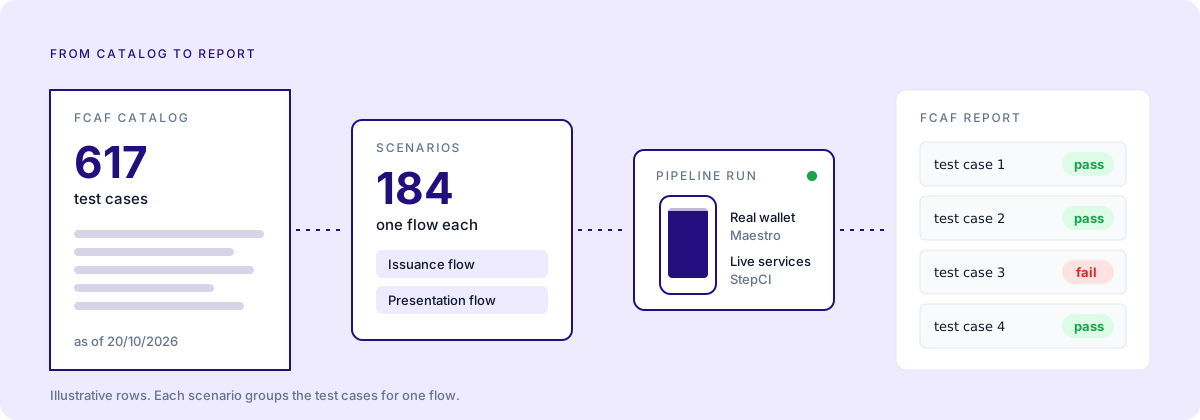
Credimi does not run those cases against a mock. A wallet behaves differently on a real device than in a unit test, and an issuer or verifier behaves differently in production than in a fixture. The catalog is only useful when it is exercised against the real thing.
How Credimi runs FCAF automatically§
Pipelines drive real wallet apps on Android devices, emulators and iOS simulators with Maestro, and call live credential issuers and verifiers with StepCI. Each run is then judged against the FCAF and protocol test cases.
A single pipeline can chain issuer → wallet → verifier end to end: the issuer sends an offer, the wallet receives and stores the credential, and the verifier requests a presentation. You see how the components behave together, not only in isolation, and the same scenario can run against many wallets. To set it up:
- Pick the suites you need: EUDI FCAF, OpenID4VCI 1.0, OpenID4VP 1.0 (plus Drafts 23 and 24), the OpenID Foundation conformance suite and WE BUILD / EWC conformance.
- Build a pipeline that chains a real issuance, a wallet interaction and a presentation, with credentials in SD-JWT VC or ISO mDoc PID.
- Run it on your own devices through a credimi-runner, or on shared devices with queueing across teams.
Protocol-level checks sit alongside FCAF in the same run. The OpenID4VCI and OpenID4VP conformance guide covers those suites in detail, and testing your EUDI wallet against real issuers and verifiers explains the device side.
FCAF test case pages on the Hub§
Every FCAF test case has its own page on the Hub, in the FCAF Wallet Solution suite. You can read what a test case checks before you run it, and link to it from your own issue tracker or release notes. For example, WS_RP_SM_DeviceBinding__007 validates the SD-JWT VC confirmation claim, and the published FCAF data model mdoc validation pipeline shows how test cases are put together into a run.
The rest of the Hub lists live wallets, credential issuers, verifiers, credentials and verification use cases, each with a working flow by QR code or deeplink. Those are the counterparts your scenarios can run against. To check which components work together beyond the FCAF catalog, see EUDI wallet interoperability testing.
The FCAF report and its evidence§
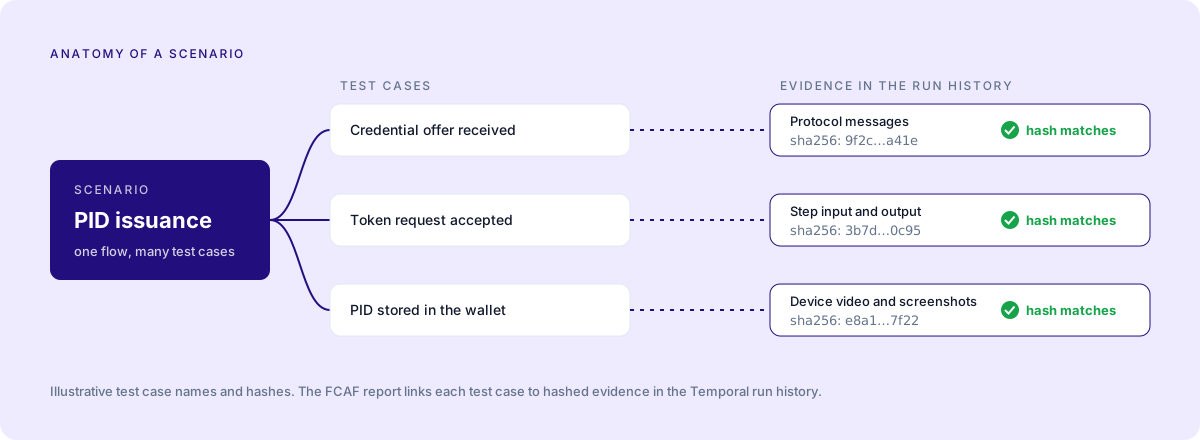
Each run is recorded in its Temporal history: every step's inputs and outputs, including the protocol messages exchanged (offers, requests and responses), each with a timestamp. The history is append-only, so nothing in it is overwritten, and the run can be replayed from it to check that it leads to the same result. The device video, screenshots, last frame and device logs are stored with the run.
The FCAF report links each test case to SHA-256 hashed evidence in that run history. An assessor does not have to take a pass or fail on trust: they can follow the link from a test case to the artifacts it came from and check that the hash matches.
Every run also produces the report as a PDF and as JSON. The PDF opens with an executive summary: passed, failed, blocked, inconclusive, skipped and not applicable counts, plus the SHA-256 of the JSON artifact that holds the raw protocol evidence. Each test case then gets its own page with the objective, preconditions, test scenario, expected results, every assertion with the evidence it was judged on, and the normative references from FCAF and the implementing regulations.
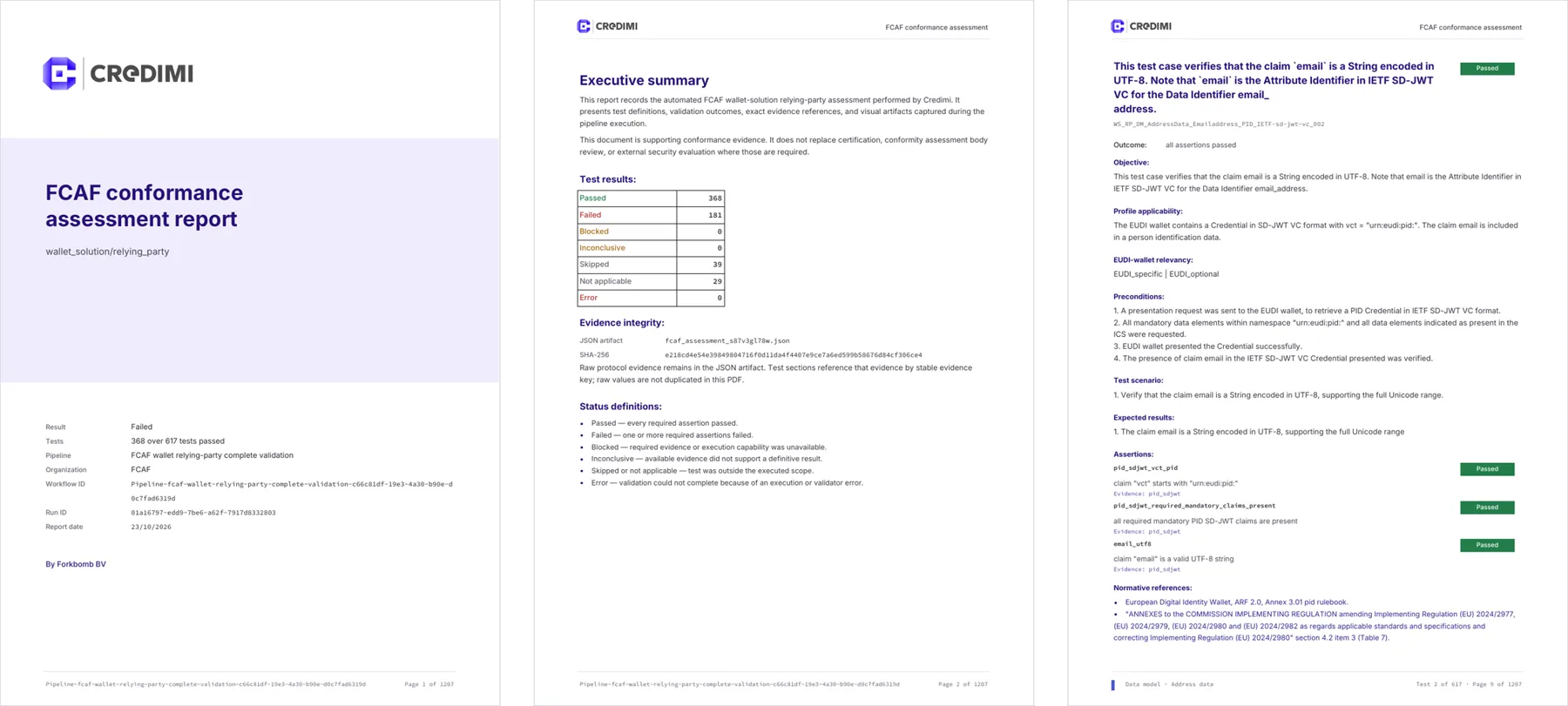
Every FCAF result in Credimi points to the evidence it came from.
Published pipelines also feed the public scoreboard, so others can see which scenarios a component runs.
Preparing for an assessment§
Credimi does not certify anything and is not a conformity assessment body. What it gives you is preparation: you find failing test cases early, fix them, and arrive at an assessment with a record of runs and the evidence behind each result.
A practical sequence for EUDIW conformance preparation:
- Read the relevant test cases on the Hub and on conformance.eudi.dev.
- Build a pipeline that covers the scenarios for your role.
- Run it until the report is clean, keeping the evidence for each run.
- Share the report and its hashed evidence with whoever performs the assessment.
Run FCAF in CI§
Conformance that is checked once drifts. The run-wallet-apk, run-issuer and run-verifier
endpoints, plus the GitHub Action, let you run
the same scenarios on every commit: upload a fresh wallet APK, or test a temporary issuer or
verifier deployment.
You can also schedule runs, watch the device live during a run, and receive results by API callback or email. The CI/CD documentation shows the setup, and what conformance automation is explains the approach.
FAQ§
How many FCAF test cases are there?§
617 test cases across 184 scenarios, as of 20/10/2026. Credimi updates this number when the catalog changes.
Is FCAF the same as the ARF?§
No. The ARF sets out the architecture and requirements for the EUDI Wallet ecosystem, while FCAF is the framework that specifies the test cases used to check conformance against those requirements.
Does passing FCAF on Credimi mean my wallet is certified?§
No. Credimi is not a conformity assessment body and does not certify wallets, issuers or verifiers. It runs the FCAF test cases and gives you a report with hashed evidence that you can use to prepare for an assessment.
Can I run only some FCAF scenarios?§
Yes. You choose the suites and scenarios that go into your pipeline, so you can start with the flows for your role and add more as you go. Credimi is open source under AGPL-3.0; you can use it at credimi.io or self-host it.
See where your wallet stands against FCAF
Browse the FCAF test cases on the Hub, then build your first pipeline.